Perfumer’s alcohol is the clear, quiet backbone of fine fragrance, the unseen architecture that lets a perfume breathe, unfold, and finally vanish like a remembered dream. At its heart it is a highly refined, skin-friendly ethyl alcohol, typically denatured with a small amount of an ingredient such as isopropyl myristate to render it undrinkable while remaining gentle on the skin. In the studio at Pink Phoenix by Amy, this clear spirit is more than a solvent; it is the luminous space in which our essential oils and botanical extracts can stretch, dance, and tell their story, an invisible vessel that supports the craft of small-batch natural perfumery without ever asking to be noticed.
The Craft Within the Clear: What Perfumer’s Alcohol Does
When we work with perfumer’s alcohol, we are working with movement. This high-proof, specially denatured ethanol gathers up volatile fragrance molecules and carries them lightly, so that a single mist can scatter top notes into the air and let them bloom with immediacy and brightness. Citrus, aromatic herbs, fleeting florals — all of these need a carrier that can lift them from the bottle, release them quickly from the skin, and allow the perfume to evolve in real time. Alcohol accomplishes this with an almost invisible elegance, evaporating as it goes so that what remains on the skin is the layered story of botanicals rather than the base itself.
Perfumer’s alcohol also serves quietly as a guardian for our natural ingredients. Essential oils and botanical distillates are living, complex materials; they are vulnerable to time, light, and exposure. A clean, high-quality alcohol base helps protect them, supporting their integrity and slowing down the forces that would flatten or cloud their nuance. In an art that leans so heavily on nature’s subtleties, preservation is not about freezing a scent in place, but about giving it a stable, respectful home from which it can speak clearly for as long as possible.
On the skin, an alcohol-based perfume has a particular way of making itself known. Because the alcohol evaporates readily, it lifts the fragrance away from the skin just enough to create a soft aura around the wearer, a gentle projection that feels like a whisper rather than a shout. This diffusion allows different facets of the composition to be perceived by both the wearer and those near them, inviting discovery over time. Where oil-based perfumes tend to sit closer and more intimately on the skin, alcohol-based perfumes can feel more airy and dimensional, making them especially suited to compositions with intricate top and heart notes that are meant to unfurl in stages.
The choice between an alcohol base and an oil base is ultimately about character and intention. Oil carriers, with their comforting slip and intimate sillage, are beautiful for close-wearing, meditative blends and for those who prefer a more cocooned experience. Perfumer’s alcohol, by contrast, lends itself to perfumes that need lift, clarity, and reach — fragrances that tell their story not just at the pulse point but in the small space between you and the world. At Pink Phoenix by Amy, we choose perfumer’s alcohol when a composition asks for that kind of articulation: when bright top notes need room to open, when a botanical heart wants to feel translucent rather than creamy, when the overall structure calls for lightness and movement.
Purity is essential here. Because perfumer’s alcohol is in direct contact with the skin and carries every other ingredient into intimate proximity, we look to the same values that guide our use of essential oils and organic botanicals. A well-made perfumer’s alcohol is neutral in odor, meticulously filtered, and chosen for its compatibility with natural ingredients and with the skin itself. While it does not offer the therapeutic dimensions that our plant materials can hold, it does shape how those therapeutics are experienced, determining how gracefully a fragrance moves, how cleanly it dries down, and how true the botanical notes remain from first mist to final trace.
As with any product applied to the skin, sensitivities are personal and unique. Even with a refined, skin-friendly alcohol base and carefully chosen botanicals, it is always wise to patch test a new perfume on a small area first and to discontinue use if any discomfort arises. Our work with perfumer’s alcohol is rooted in care, but your own body’s response is the final, most important guide.
Cultural & Historical Significance: The Spirit of Perfumery
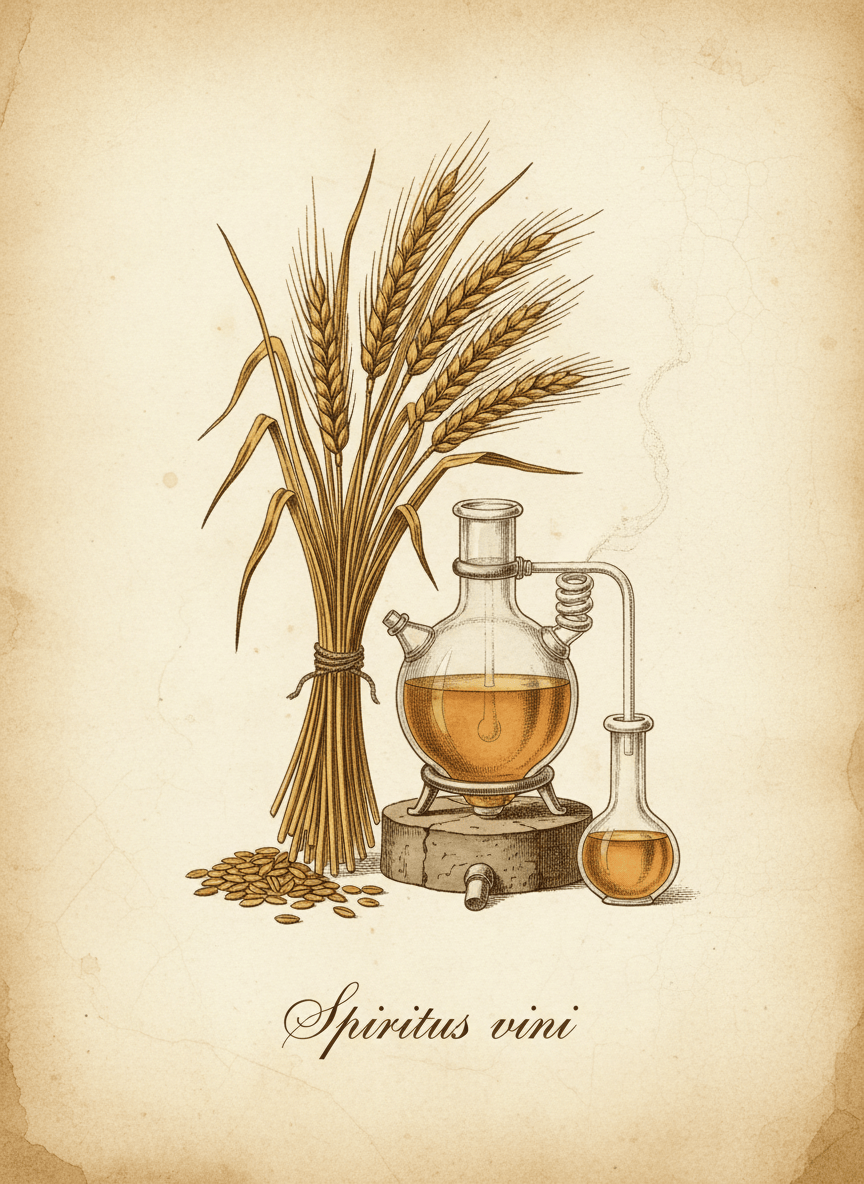
The story of perfumer’s alcohol is entwined with the long human fascination with distillation itself. Long before it was used in fine fragrances, the earliest forms of distilled spirits emerged from experiments in alchemy and medicine, as practitioners sought to concentrate the “spirit” of plants and substances into potent essences. In the ancient and medieval worlds, these clear liquids were regarded as precious and somewhat mysterious, a convergence of fire, water, and vapor that yielded something altogether new. It is within this context that alcohol found its way into perfumery, first as a curious possibility and then as a transformative medium.
Islamic scholars played a profound role in refining distillation and expanding what could be done with it. Ibn Sina, known in the West as Avicenna, is often credited with perfecting the process of steam distillation and exploring its application to aromatic plants, laying essential groundwork for both modern perfumery and herbal medicine. While fragrant oils and resins had long been used in unguents and balms, the emergence of distilled alcohol as a base opened the door to a different kind of perfume: one that was clearer, lighter, and capable of capturing the fleeting beauty of volatile aromatics in a way that ointments could not. The early alcohol-based perfumes that followed were a merging of scientific curiosity and sensory devotion.
By the seventeenth and eighteenth centuries, alcohol-based fragrances had begun to take recognizable form in Europe, most notably in the creation of Eau de Cologne. These lively, citrus-forward waters, built on high-proof spirits and bright plant materials, signaled a shift in how fragrance could be worn and experienced. No longer confined to heavy, oily preparations, perfume could now feel crisp, refreshing, and almost weightless, a daily adornment rather than an occasional indulgence. From there, the use of alcohol as the standard base for fine fragrance settled in, and the clear spirit became the canvas upon which perfumers painted increasingly complex compositions.
France, and particularly the region of Grasse, rose as the quiet capital of this evolving art. Fields of roses, jasmine, and orange blossoms supplied the raw materials, while distilleries and workshops honed the techniques needed to marry these botanicals to alcohol with precision. Over time, the association between alcohol-based perfume and luxury became almost instinctive. A glass flacon of clear, fragrant liquid came to symbolize refinement, intimacy, and a certain cultivated pleasure in the everyday. In the twentieth century, as industrial production expanded, this luxury became more democratic; perfumer’s alcohol carried not only niche creations, but also vast, globally known scents that threaded themselves through collective memory.
Yet, as fragrance became increasingly industrialized and synthetics took center stage, something of the earlier intimacy between plant, spirit, and handcraft was set aside. The recent resurgence of natural, small-batch perfumery is, in many ways, a return to that relationship. For artisans working with essential oils and organic ingredients, perfumer’s alcohol is not just a neutral medium but a chosen collaborator. It must be clean, respectful to the botanicals, and aligned with the maker’s values. In this context, alcohol is reclaimed from the anonymity of mass production and restored as a craft material: measured, blended, and bottled with the same attention that goes into sourcing a particular rose or resin.
At Pink Phoenix by Amy, we see ourselves as part of this quiet lineage. Our use of perfumer’s alcohol is a continuation of a story that stretches from early distillation experiments to the citrus fountains of Cologne, from the flower fields of Grasse to the intimate scale of a modern studio. We work with alcohol because it allows our natural, organic components to shine in a way that feels true to their character, and because it connects our contemporary practice to the deeper history of perfumery itself.
Closing Reflection: The Spirit That Carries the Story
In every bottle we blend, there is a moment when the botanicals meet the clear, waiting spirit of perfumer’s alcohol and the perfume finally comes into focus. It is a quiet alchemy: essential oils, resins, and distillates gathered from the living world, suspended in a medium that will lift them, protect them, and then gracefully disappear. At Pink Phoenix by Amy, even this functional, invisible element is chosen with intention. We lean into an alcohol base not simply because tradition suggests it, but because it allows our natural, organic ingredients to move as they wish to move, to open tenderly and then linger as a memory on the skin. From the first bright breath to the softest final trace, every part of the perfume — from the most celebrated note to the clear spirit that carries it — is considered, crafted, and cared for here in northwest Indiana, with the same quiet reverence that guides all of our work.
 Pink Phoenix by Amy
Leave a comment