Pip: Pink never asked for permission — it just showed up, outlasted every label pinned to it, and apparently inspired an entire fragrance brand. Classic pink move.
Mara: That's the territory Amy covers across this episode's posts — the deep cultural history of pink as a colour, and the mythology of the phoenix as a symbol of transformation. Two subjects that turn out to share more DNA than you'd expect.
Pip: Right — because both of them refuse to mean just one thing, which is either very poetic or very inconvenient, depending on your filing system.
Mara: Let's start with the colour itself, and what it's actually carried across centuries.
Pink And Its Cultural Meanings
Pip: The question here is deceptively simple: what does pink actually mean, and who decided?
Mara: The post traces the word back before it was even a colour — "before it was a colour, 'pink' was a flower: Dianthus, with its fringed petals that looked as though they had been delicately cut with pinking shears. The blossom came first; only later did its gentle, vivid hue lend its name to an entire family of colours."
Pip: So the colour borrowed its name from a flower, which is either charming or the least efficient naming system imaginable. But the real upshot is that pink existed in the world for centuries before English even had a word for it — seen, but not yet claimed.
Mara: And the historical reversal is striking. The post is clear that associating pink with femininity is recent — guidance literature once called pink the stronger, more decided colour, recommending it for boys, while blue was considered delicate and aligned with girls.
Pip: That's the detail that earns its place — the entire modern colour-coding of childhood is essentially a mid-century marketing decision, not some ancient truth.
Mara: From there, the post moves through pink in nature, in Rococo courts, in punk subculture, and into perfumery, where certain scent notes — rose, peony, lychee — register as pink even though they're invisible. The argument is that pink is less a fixed category than a living negotiation between culture and perception.
Pip: Which lands us exactly where the brand name does — at a colour that's been sacred, anarchic, aristocratic, and everything between.
Phoenix Legends And Rebirth
Pip: The phoenix question runs parallel: where does this symbol come from, and why does it keep surviving its own reinvention?
Mara: The post traces it back before the Greek word existed. Ancient Egypt's Bennu bird — associated with the sun god Ra — "was said to appear at the moment of creation, a radiant bird perched on the primordial mound as the first light broke over the waters." Not a symbol of rebirth so much as a witness to beginnings.
Pip: So the phoenix's oldest ancestor wasn't about destruction and recovery at all — it was about being present at the start of everything. That reframes the whole myth.
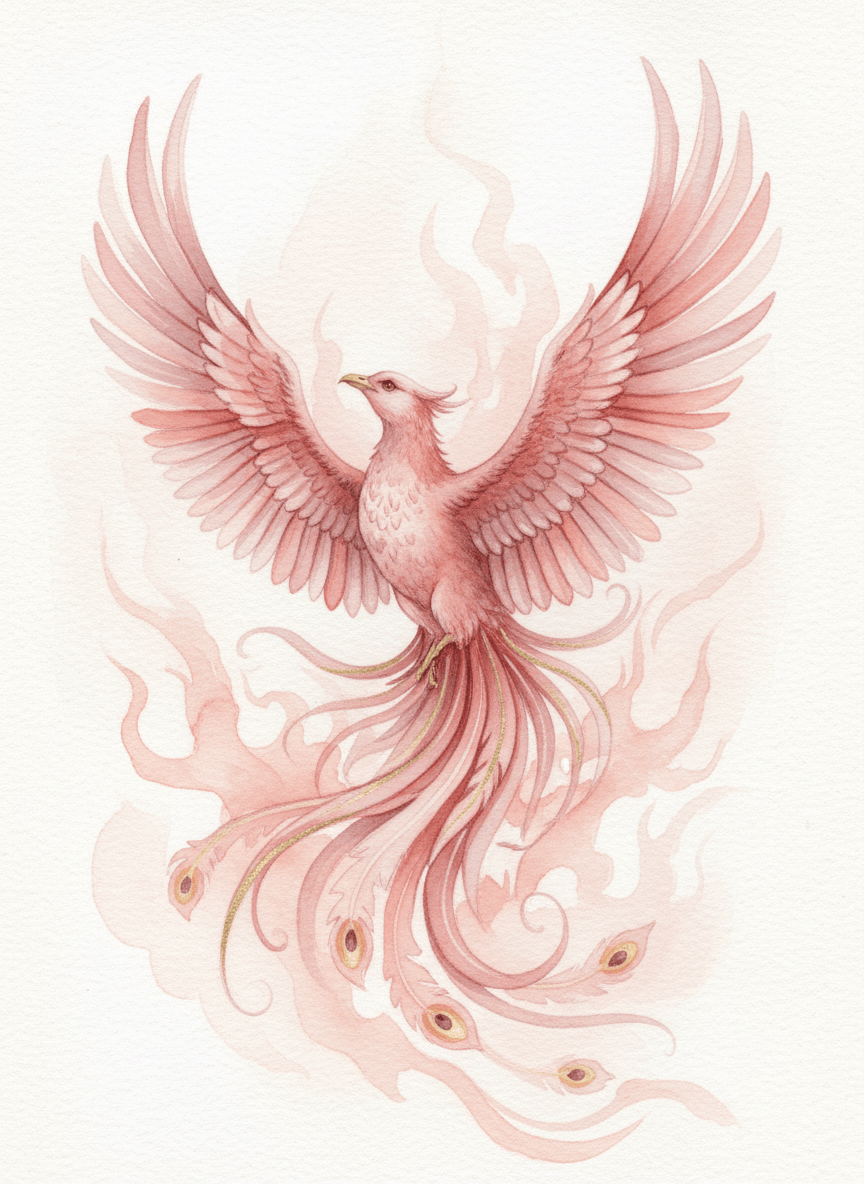
Mara: The Greek and Roman versions add the fire and the aromatic pyre — Herodotus describes a nest of myrrh and resins, ignited, with the bird rising from the fragrant ash. The post connects this directly to incense ritual: fragrance released by burning as a bridge between earth and sky.
Pip: Death drenched in sweetness, as the post puts it. Which is either the most beautiful thing or the most dramatic way to describe aromatherapy.
Mara: The post is careful to show that not every culture's version involves destruction. The Persian Simurgh is a bird of guidance and healing, older than memory. The Chinese Fenghuang carries no ash at all — it embodies harmony, the feminine principle, a world in tune with itself.
Pip: So the fire is one version of the story, not the only one. The common thread is transformation — the idea that some form of change is necessary before something truer can emerge.
Mara: The alchemical tradition picks that up directly. The post describes the phoenix appearing in alchemical manuscripts "atop flames, perched on crucibles," representing the Magnum Opus — the process of burning away what is coarse to reveal what is essential.
Pip: And the post draws a straight line from there to natural perfumery — distillation as a quieter phoenix myth, botanical matter passing through heat to yield something concentrated and alive.
Mara: The post puts it this way: the raw botanicals "have passed through a refining journey, shedding bulk and form to reveal their most intimate, volatile selves. What remains in a small glass vial is powerful and weightless at once, ready to awaken on warm skin."
Pip: Weightless and powerful — that's the phoenix in a sentence, and also, apparently, what's in the bottle.
Mara: The post closes by tying both symbols together: pink for tenderness and embodiment, phoenix for resilience and the long arc of change. The argument is that the name isn't decorative — it's a position.
Pip: Two colours, one bird, centuries of meaning — and somehow it all points to the same idea: that softness and strength aren't opposites.
Mara: That tension is what both posts keep returning to. Next time, we'll see where the work goes from here.
 Pink Phoenix by Amy
Leave a comment